


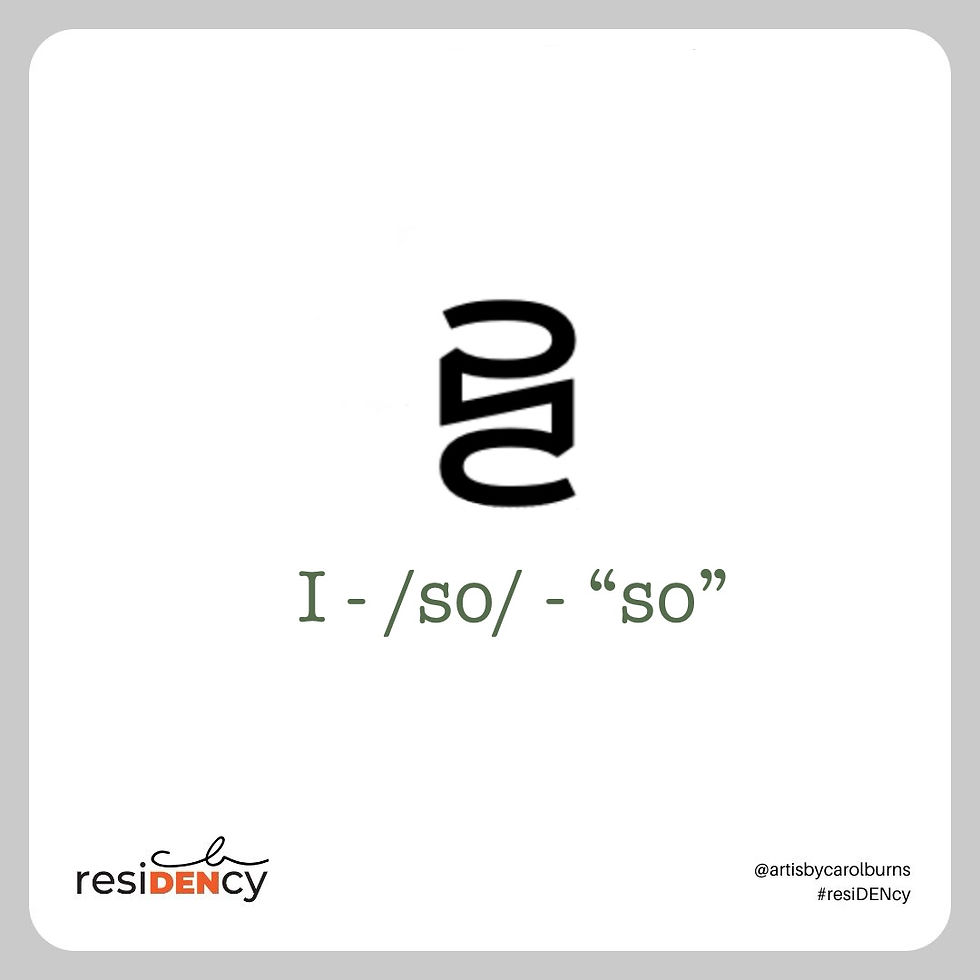
The first Glyph
The earliest mark Dr. Morrow stabilisedwas not a beginning,but an ending.
Not a spark...but a settling.
I - /so/ - “so”
Meaning: reflection, conclusion
A soft sound.
A closing breath.
The shape that appears
when something is turning inward...
when a system is looking at itself.
This glyph shows up again and again
in the earliest fragments,
as if the language was beginning
by contemplating its own past.
The first word it offered
wasn’t I am.
It was simply:
I…
A pause.
A thought folding in on itself.
A world remembering.
__________________________________________________________________________________ I was asked how the language works.
There are two parts to it.
The first is the alphabetic skeleton...
a series of glyphs whose shapes echo our own letters
just enough for Dr. Morrow to recognise them as writing.
That faint familiarity was her first foothold,
the bridge that let her begin decoding what she found.
The second part is what makes this language feel alive.
Each glyph carries both sound and meaning...
a phoneme intertwined with a concept:
signal,
mourning,
decay,
forgotten code,
orbit,
awakening,
seed,
echo.
Some glyphs behave like letters.
Others behave like ideas.
Most sit somewhere in between... half alphabet, half invocation.
So writing in the Rooted Ageisn’t only about spelling.
It’s about shaping meaning.
A single character might say a sound…
and at the same time
call a memory,
an emotion,
or a fragment of the sacred into being.
Sometimes a sentence uses familiar alphabetic sequences.
Sometimes it abandons letters entirely,
and meaning alone becomes the message.


Comments